



Explained
Multi-Tenant Active Directory: A Practical Guide
What multi-tenant Active Directory means, shared forests, separate forests with trusts, Entra multitenant organizations, and how to design and secure each.
Eight NinjaOne alternatives for internal IT and MSPs, compared on RMM and MDM depth, platforms and published pricing, with NinjaOne's own price range.

Content writer, trio.so
The main NinjaOne alternatives split into two groups. MSPs usually compare RMM suites: Atera, SuperOps, ConnectWise RMM and N-able N-central. Internal IT teams usually compare endpoint management tools: Microsoft Intune, ManageEngine Endpoint Central, Hexnode and trio.so. NinjaOne is an RMM-first platform that also includes device management, backup and remote access, so the right alternative depends on whether you need RMM depth, mobile and Apple management, or a different price model.
If you run NinjaOne today, or have it on a shortlist, this guide shows NinjaOne's own published pricing, compares eight alternatives in both groups and helps you decide which group you belong to.
NinjaOne is widely used for Windows monitoring, patching and remote access. The reasons teams compare it with other tools are usually these:
NinjaOne's pricing page, checked on 8 November 2026, says its per-device pricing starts as low as $1.50 per month at 10,000 endpoints and rises to $3.75 at 50 or fewer. Pricing varies by region and by the products you buy, and NinjaOne offers a 14-day free trial. For a 40-device company, that is about $1,800 a year before add-ons.
These are RMM suites built for service providers. Prices come from each vendor's own site, checked on 8 November 2026.
Atera prices per technician with unlimited endpoints, so the cost stays the same as you add devices. Every plan includes its AI copilot, ticketing and a service portal, patch management, remote access and an agent for Windows, Mac and Linux. It offers a 30-day free trial.
See trio.so vs. Atera.
SuperOps sells RMM and PSA. Its Prime plan covers Windows, macOS and Linux endpoints with patching, remote troubleshooting, network monitoring and a service desk, and Prime Plus adds mobile device management for iOS, iPadOS and Android. It prices per endpoint per month on request, with a 150-endpoint minimum per plan and a free trial.
See trio.so vs. SuperOps.
ConnectWise RMM monitors and manages Windows, macOS, Linux, network and cloud devices, with automated patching, scripting in PowerShell, bash and batch, and remote access through ScreenConnect. It is aimed at MSPs and IT service teams.
N-central is N-able's endpoint management platform with RMM, aimed at MSPs and IT teams. It covers patch and vulnerability management, automation and security options such as EDR, with a free trial.
These tools focus on managing an organization's own devices, including phones, tablets and Macs.
Intune manages Windows, macOS, iOS/iPadOS, Android and some Linux devices and is included in Microsoft 365 E3 and E5. Standalone, Intune Plan 1 is $8 per user per month.
Endpoint Central combines endpoint management with patching and security add-ons, in the cloud or on premises. ManageEngine lists Windows, macOS, Linux, iOS, iPadOS, Android, ChromeOS and tvOS. It publishes $795 per year for 50 endpoints for the Professional edition and offers a free edition for up to 25 endpoints.
Hexnode is a multi-platform UEM for Windows, macOS, iOS, Android and Linux. It publishes Pro at $2.2, Enterprise at $3.2 and Ultimate at $4.7 per device per month, with Ultra on request and a 14-day trial.
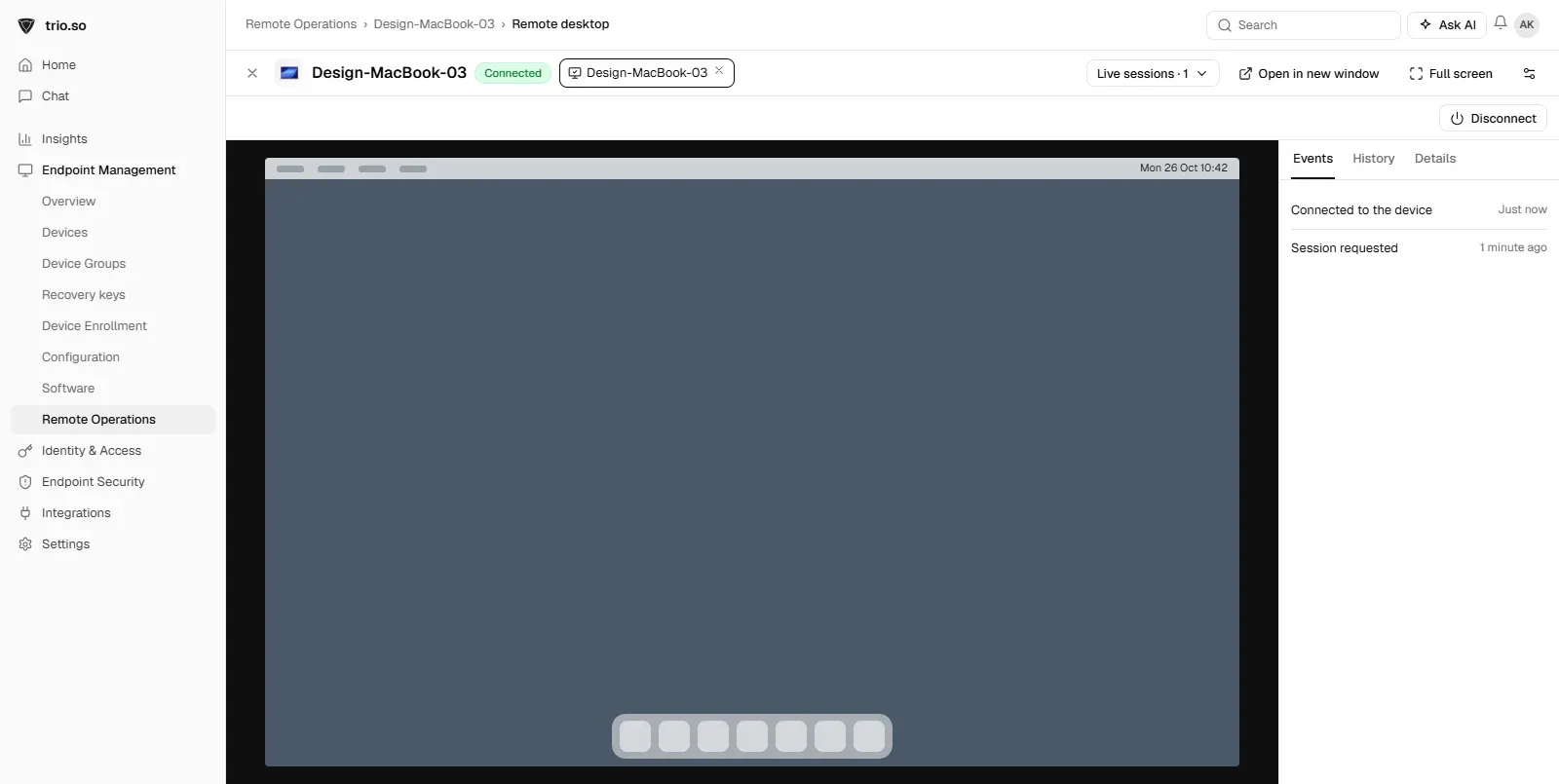
trio.so manages Windows, macOS, Linux, iOS/iPadOS and Android devices from one console, priced per device with no device minimum. Remote desktop and terminal are included in every plan. Its patch findings list each CVE with its CVSS and EPSS scores and whether it is in the CISA Known Exploited Vulnerabilities catalog, operating system updates run through Auto Patch policies, and third-party fixes run through remediation plans.
For MSPs, trio.so manages several client companies from one console, with each client's devices, users and policies kept separate. For a head-to-head view, see trio.so vs. NinjaOne.
| Tool | Type | Platforms | Price model (published) |
|---|---|---|---|
| NinjaOne | RMM with MDM | Windows, macOS, Linux, mobile | Per device, $1.50 to $3.75 |
| Atera | RMM and ticketing | Windows, Mac, Linux | Per technician, unlimited endpoints |
| SuperOps | RMM and PSA | Windows, macOS, Linux; iOS, iPadOS, Android in Prime Plus | Per endpoint, on request, 150 minimum |
| ConnectWise RMM | RMM | Windows, macOS, Linux, network | Not published |
| N-able N-central | RMM and UEM | See vendor | Not published |
| Microsoft Intune | UEM | Windows, macOS, iOS/iPadOS, Android, Linux | Per user, $8 (Plan 1) |
| ManageEngine Endpoint Central | UEM | Windows, macOS, Linux, iOS, iPadOS, Android, ChromeOS, tvOS | $795 per year for 50 endpoints |
| Hexnode | UEM | Windows, macOS, iOS, Android, Linux | Per device, from $2.2 |
| trio.so | UEM | Windows, macOS, Linux, iOS/iPadOS, Android | Per device, from $5 |
Both, with RMM at its core. NinjaOne grew as a remote monitoring and management tool for MSPs and IT teams, and it now includes mobile device management, backup and remote access. If most of your work is monitoring and patching Windows endpoints, an RMM suite is the closer match. If you manage many phones, tablets and Macs, or you need automatic enrollment through Apple and Android programmes, an MDM or UEM tool is the closer match. For more on the difference, see RMM tools and unified endpoint management.
trio.so manages Windows, macOS, Linux, iOS/iPadOS and Android devices from one console, with remote desktop and terminal in every plan, patch findings with CVSS, EPSS and KEV data, and Auto Patch policies for operating system updates. MSPs can manage several client companies from the same console. Plans start at $5 per device.
For MSPs: Atera, SuperOps, ConnectWise RMM and N-able N-central. For internal IT: Microsoft Intune, ManageEngine Endpoint Central, Hexnode and trio.so.
NinjaOne publishes per-device pricing from $1.50 per month at 10,000 endpoints up to $3.75 at 50 or fewer, varying by region and products, with a 14-day free trial.
ManageEngine Endpoint Central has a free edition for up to 25 endpoints. Most others, including Atera, SuperOps and Hexnode, offer free trials rather than free plans.
It depends on your price model and stack. Atera prices per technician with unlimited endpoints, SuperOps combines RMM and PSA with a 150-endpoint minimum, and ConnectWise RMM and N-able N-central suit larger MSPs that buy through sales.
Both, with RMM at its core. It includes mobile device management, but teams with many phones, tablets and Macs often compare it with dedicated MDM or UEM tools.
Related reading: RMM tools, what is an MSP and unified endpoint management.
trio.so includes remote desktop and terminal in every plan and manages all five platforms. Plans start at $5 per device.
Every organization today needs a solution to automate time-consuming tasks and strengthen security. Without the right tools, manual processes drain resources and leave gaps in protection. trio.so is designed to solve this problem, automating key tasks, boosting security, and ensuring compliance with ease.
Every organization today needs a solution to automate time-consuming tasks and strengthen security. Without the right tools, manual processes drain resources and leave gaps in protection. trio.so is designed to solve this problem, automating key tasks, boosting security, and ensuring compliance with ease.





Have questions? We've got answers. This section covers some of the most commonly asked questions related to this topic.
Related
The related industry news, interviews, technologies, and resources.
What multi-tenant Active Directory means, shared forests, separate forests with trusts, Entra multitenant organizations, and how to design and secure each.
What Citrix Endpoint Management is today, six alternatives compared on platforms, deployment and pricing, and how to plan a move off it.
Eight Hexnode alternatives compared on platforms, Windows depth, Linux support and published pricing, with what to check before you switch MDM.
Seven SimpleMDM alternatives compared on platforms and published pricing, with SimpleMDM's own plans and what to check before you switch.
Seven Mosyle alternatives compared on platforms and published pricing, with Mosyle's own plans and what changes when your fleet adds Windows or Android.
Seven GFI LanGuard alternatives for patching and vulnerability scanning, compared on platforms, deployment and pricing, and how to pick one.
Eight Jamf alternatives compared on platforms, starting price and minimums, with Jamf's own pricing and what switching from Jamf involves.
Seven Addigy alternatives for MSPs and internal IT, compared on platforms and published pricing, with Addigy's own prices and what switching involves.
14-day free trial. No credit card required.
trio.so for MSPs: one console, separate clients